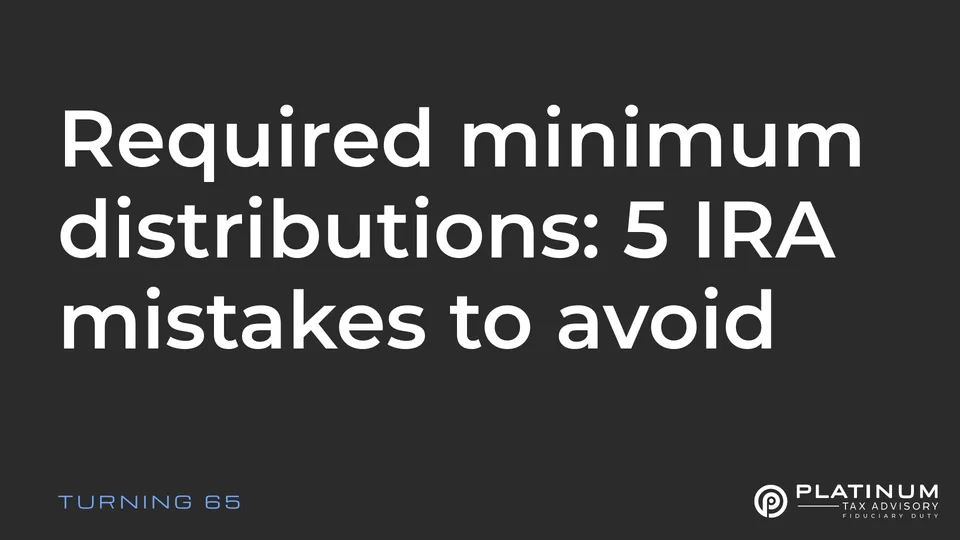
Once you reach a certain age, the IRS requires you to start taking money out of most tax-deferred retirement accounts every year. These are required minimum distributions, or RMDs, and the rules trip up a lot of retirees.
- RMDs generally begin at age 73 (75 if you were born in 1960 or later), and each one after the first is due by December 31.
- Traditional IRA RMDs can be added up and taken from any one IRA; 401(k) RMDs generally come from each plan separately.
- A missed RMD triggers a 25% excise tax, which can drop to 10% if you correct it promptly.
- A qualified charitable distribution can count toward your RMD without adding to your taxable income.
1. Missing your start date
RMDs generally begin at age 73 (75 if you were born in 1960 or later). You can delay your first one until April 1 of the following year, but every RMD after that is due by December 31. Delaying the first one means taking two in the same year, which can push you into a higher bracket.
2. Taking the wrong amount
Your RMD is based on your account balance at the end of the prior year, divided by a life-expectancy factor from IRS tables. Using the wrong balance, or the wrong table, can mean taking too little.
3. Mixing up which accounts can be combined
You can add up the RMDs for all of your traditional IRAs and take the total from any one of them. But 401(k) RMDs generally must be taken from each plan separately.
4. Not fixing a missed RMD quickly
Missing an RMD triggers a 25% excise tax on the amount you should have taken. If you correct it promptly, that can drop to 10%. If you realize you’ve missed one, act quickly and talk with your tax preparer.
5. Overlooking smarter ways to take it
From age 70½, you can give directly from your IRA to charity through a qualified charitable distribution. It counts toward your RMD and isn’t included in your taxable income. Planning withdrawals earlier, or converting to a Roth in lower-bracket years, can also shrink future RMDs. Roth IRAs don’t require minimum distributions for the original owner.
RMDs are predictable, which means they can be planned. A little preparation before you turn 73 can keep more of your savings working for you.
Book an RMD reviewSources and references
This article is general information, not tax advice for your situation. Rules change; talk with a qualified professional before acting.
Get plain-English tax tips by email
A few emails a month from Mary on taxes, Medicare, Social Security and retirement. Free, and you can unsubscribe anytime.